Showing posts with label New Cars. Show all posts

How much that new car will really cost


Whatever you're comfortable spending on a car, the cost of buying it will be dwarfed in the long run by ongoing expenses in depreciation, fuel, insurance, financing, maintenance and repair, and more. Consumer Reports has gone to great lengths to estimate owner costs for nearly every new car that's currently on sale. And we found some surprises:


For example, you could save more than $7,000 over five years by buying a Toyota Highlander SUV instead of a Ford Explorer, even though the Highlander costs $3,000 more up front. The Highlander makes up for its higher sticker price in lower depreciation and maintenance and repair costs over the years.


Depreciation makes up by far the largest cost of owning any car, comprising up 48 percent of the cost over the first five years. Fuel comes in a distant second at 24 percent.

Many consumers are concerned about the cost of maintenance and repairs. But even on the most expensive cars, mechanics' bills don't add up to half the cost of depreciation on the cheapest car in our survey.

Insurance is another cost that can take people by surprise. For example, while other costs on small cars are low, insurance costs are higher than with larger cars. The Chevrolet Cruze can cost almost twice as much as a similarly priced Volkswagen Jetta a year.


Our owner cost comparisons bring these differences to light, and the information is readily available on our model pages. There you can see how much it costs to own a car for 1, 3, 5, and 8 years. We'll be digging deeper into the data here on the blog in the days ahead. In the meantime, here are a few of the most and least expensive cars to own, by category.


Make, model & type Cost/yr over 5 years Make, model & type Cost/yr over 5 years

Sporty cars & convertibles Small SUVs
Best Mini Cooper Hatchback Base $5,750 Toyota RAV4 (4-cyl.) $7,000
Worst
Jaguar XK $19,000 Cadillac SRX $11,750

Small cars Midsized SUVs
Best
Toyota Prius C $5,000 Chevrolet Equinox/GMC Terrain (4-cyl.) $8,000
Worst Chevrolet Cruze Eco $7,500 Jeep Grand Cherokee (V8) $12,750

Family sedans Large & Luxury SUVs
Best
Toyota Camry Hybrid $6,500 Ford Flex V-6 $10,500
Worst Volkswagen Passat (V-6) $9,250 Cadillac Escalade (base) $17,250

Upscale cars Wagons & minivans
Best
Buick Verano (2.4) $7,750 Toyota Prius V $6,000
Worst Chrysler 300 C $11,500 Volvo XC70/Chrysler Town & Country $10,750

Luxury cars Light-duty pickups
Best
Hyundai Genesis 4.6 $11,000 Toyota Tacoma (V-6) $8,500
Worst BMW 750Li $21,500 Chevrolet Avalanche $13,000

Copyright © 2006-2012 Consumers Union of U.S., Inc. No reproduction, in whole or in part, without written permission.

source

News Summary: New government gas mileage rules

The Obama administration on Tuesday finalized regulations that will force automakers to nearly double the average gas mileage of all the new cars and trucks they sell in 2025. All new vehicles would have to average 54.5 miles per gallon in 13 years.

THE IMPACT: The change cuts in half the greenhouse gases produced by the vehicles, and the government says it will save consumers $8,000 in gasoline costs over the life of a vehicle purchased in 2025. But in the arcane world of government regulations, it doesn't mean cars will actually get 54.5 mpg. In real-world mileage, they'll average about 40 mpg.


THE COST: The government says the regulations will drive up the cost of a new car by about $2,800 in 13 years, and critics say that will make them too expensive for many people.

Drivers are being hit with the biggest one-day jump in gasoline prices in 18 months just as the last heavy driving weekend of the summer approaches.

As Hurricane Isaac swamps the nation's oil and gas hub along the Gulf Coast, it's delivering sharply higher pump prices to storm-battered residents of Louisiana and Mississippi — and also to unsuspecting drivers up north in Illinois, Indiana and Ohio.

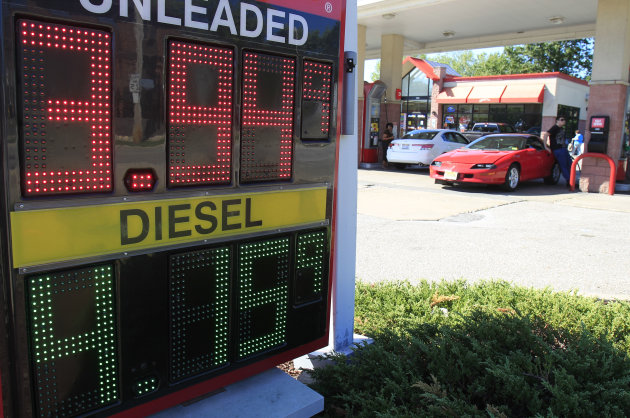
The national average price of a gallon of gas jumped almost five cents Wednesday to $3.80, the highest ever for this date. Prices are expected to continue to climb through Labor Day weekend, the end of the summer driving season.

"The national average will keep ticking higher, and it's going to be noticeable," says Patrick DeHaan, senior petroleum analyst at Gasbuddy.com

The wide storm shut down several refineries along the Gulf Coast and others are operating at reduced rates. In all, about 1.3 million barrels per day of refining capacity is affected. So, it's no surprise that drivers in Louisiana, Alabama, Mississippi and Florida saw gas prices rise by a dime or more in the past week.

But some states in the Midwest are suffering even more dramatic spikes. Ohio prices jumped 14 cents, Indiana prices soared 13 cents and Illinois prices jumped 10 cents on Wednesday alone according to the Oil Price Information Service. Days before Isaac is expected to douse those states with rain, the storm forced the shutdown of a pipeline that serves a number of Midwest refineries.

Drivers in the region were angry and confused. "''I saw gas in my neighborhood for $3.56 a gallon just Tuesday morning, and now I'm paying $3.95. It's terrible," said Mary Allen of Cincinnati as she paid $20 for just over five gallons of gas. She wondered how Isaac could drive up gas prices in Ohio — and then resigned herself to a holiday weekend without travel.

The price surge is happening at the wrong time and the wrong place for Dickson Stewart, a 56-year-old electronics consultant, who is driving from Minneapolis to Savannah, Ga. this week. He stopped at a BP station in downtown Chicago Tuesday — home to some of the highest retail prices in the country — and paid $4.49 a gallon to fill up his Jeep Wrangler.

Stewart expects gas prices to fall after Labor Day. Analysts say he's probably right.
As Isaac fades away, the summer driving season ends, and refiners switch to cheaper winter blends of gasoline, stations owners should start dropping prices. "There is some very good relief in sight," DeHaan says.

When Katrina hit in 2005, the national average for gas spiked 40 cents in six days and topped $3 per gallon for the first time. Isaac likely won't have the same result, though its full impact on the refineries is yet to be determined.

The refineries are not expected to suffer long term damage. But refiners decided to shut down or run at reduced rates to protect their operations.

These facilities consume enormous amounts of electric power and generate steam to cook crude oil into gasoline, diesel, jet fuel and heating oil. If a refinery loses power suddenly, operators can't properly clear the partially cooked oil out of pipes, and re-starting the refinery can take several days or even weeks.

In advance of Isaac, refineries instead conducted what is known as an orderly shutdown, so they can re-start as soon as the power supply is assured again. The Gulf refineries will likely stay off line for about three days.

Isaac cut into the amount of gasoline being produced, and raised fears that supplies could fall dangerously low if the storm proved worse than expected. When supplies drop or are threatened, wholesale prices rise. Then distributors and station owners have to pay more to fill up their station's tanks. They then raise their prices based on how much they paid for their current inventory, how much they think they will have to pay for their next shipment, and, how much their competitors are charging.

Prices spiked particularly high in the Midwest because Isaac forced Shell to close a pipeline that delivers crude from St. James, La. to refineries in the region.

Gasoline prices are particularly vulnerable to spikes around this time of year. Refiners keep a low supply of more expensive blends as driving season ends, knowing they'll soon be able to make cheaper winter blends of gasoline.

"We are really working with a just-in-time delivery system," said Tom Kloza, chief oil analyst at the Oil Price 


Pump prices were on the rise even before Isaac blew in. The average price for gas rose about 40 cents from July 1 to mid-August because of higher oil prices and refinery problems in the Midwest and West Coast. At $3.80 per gallon, the national average is the highest since May 1 and well above the previous record for Aug. 29, $3.67 in 2008.

Wednesday's jump of a nickel was the 10th biggest one-day jump on record, according to OPIS, and the biggest since the average price rose 6 cents on February 15, 2011 when turmoil in Libya was rising.

But prices could quickly come down if refineries can soon get up and running. Crude oil prices fell Wednesday and wholesale gasoline prices fell the past two days, suggesting the spike in retail gasoline prices could be short-lived. Americans will soon do less driving and the switch to cheaper blends will be well underway by mid-September.

That's still too late for Sharon Simon of Gadsden, Ala. She's driving 900 miles north to her daughter's wedding in Olean, N.Y. this weekend, and will now have to spend an extra $30 to $50 on gasoline for the trip. "Just as we are getting ready to head out the prices go up," she said. "I'm fed up with the surge in price every time there is a holiday."


U.S. Army names three finalists to replace the Humvee in $5 billion bake-off


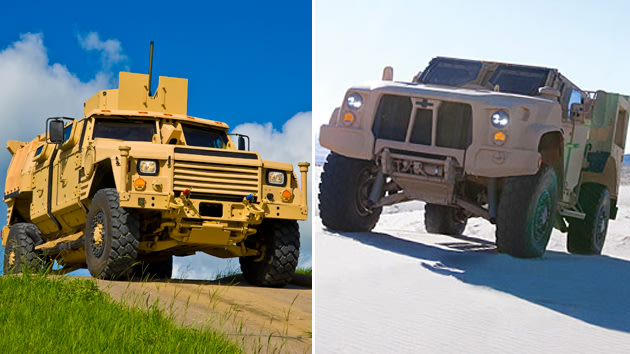
In the lingo of the U.S. Army, the next-generation of battle trucks will be known as the Joint Light Tactical Vehicle. To everyone else, it's known as the replacement for the Humvee -- and one of the few multibillion-dollar U.S. defense contracts still up for grabs. On Wednesday, the Army narrowed its list of potential Humvee successors to three. Here's a look at what the 21st-century jeep will look like.

The winners -- AM General, builder of the current Humvee; Lockheed Martin and Oshkosh Corp. -- beat out three other teams from Navistar, General Dynamics and BAE Systems. The three top entrants won contracts worth about $60 million each to build a small fleet of demonstration models that will be tested by the Army. Whichever team prevails will win a contract to build 20,000 vehicles for the U.S. Army and another 5,000 for the Marines at an estimated cost of $5 billion; the eventual deal could be worth far more depending on options and whether other countries buy the same vehicle -- a rare opportunity in a era where the Defense Department faces up to $1 trillion in budget cuts.

Compared to the current Humvee, the new designs offer far more interior space; compared to the original World War II-era Jeep, they're tanks with wheels that can travel farther and faster over rough terrain and rivers. While required to be less expensive per vehicle, all were designed to withstand blasts from mines and roadside bombs, a leading killer of U.S. troops in Iraq and Afghanistan.


The Lockheed Martin JLTV and the Oshkosh L-ATV

AM General's BRV-O entry sports a 3,500-lb. payload, self-leveling suspension and a 3.2-liter, 300-hp turbocharged six-cylinder diesel meant to be far more fuel-efficient than the V-8s used in the Humvee. Lockheed Martin says its JLTV has been designed to minimize weight -- allowing it to be hauled by helicopter -- while avoiding high-cost materials like titanium. And the Oshkosh L-ATV offers a suspension designed to give its wheels 20 inches of vertical movement over inhospitable terrain.

The companies will deliver their testing units to the Army over the next year; the Army will take two more years to test before picking a winner sometime in 2015. Here's hoping by then there will be less demand for hauling Americans into harm's way.

source

New 200-mph supercar promises 69 mpg

For the past few decades, various British engineers and businessmen have attempted to build sports cars under the Trident name with as much luck as a broken umbrella in London. Today, Trident announced it would finally show its production-ready car in public next month -- the Trident Iceni Grand Tourer, a diesel-powered machine that should hit 200 mph while returning 69 mpg on a variety of fuels. It could be fantastic -- if it's for real.


The latest version of Trident says it's using a 6.6-liter turbocharged diesel that combined with some undescribed system its calling Torque Multiplication that's good for 430 hp and 950 ft.-lb. of torque; those with additional pounds at their feet can pay for upgrade to 660 hp and 1,050 ft.-lbs. In the base version, the Iceni can reach 60 mph in 3.7 seconds.

By using a diesel, the Iceni GT can burn a variety of fuels, from regular diesel to used restaurant oils, and at cruising speed of 70 mph, can travel 2,000 miles on a tank of gas. If all these figures sound too good to be true, it's because they are a bit; it's not that diesel engines aren't capable of fantastic performance, but that the technology for doing so usually takes more engineering than a handful of people can pull together. While Trident didn't reveal much about the engine, General Motors builds a 6.6-liter diesel in its trucks good for 397 hp and 765 ft.-lbs.

Trident also didn't release the weight of the Iceni, which should be a substantial disadvantage to any of its competitors. With the company taking orders next month and vowing production by the end of the year with a starting price of $119,000, we'll see how sharp this Trident is soon.

source